
27 Mar A new mission and a broader vision: eye square User Experience Research is now called User Insights and UX
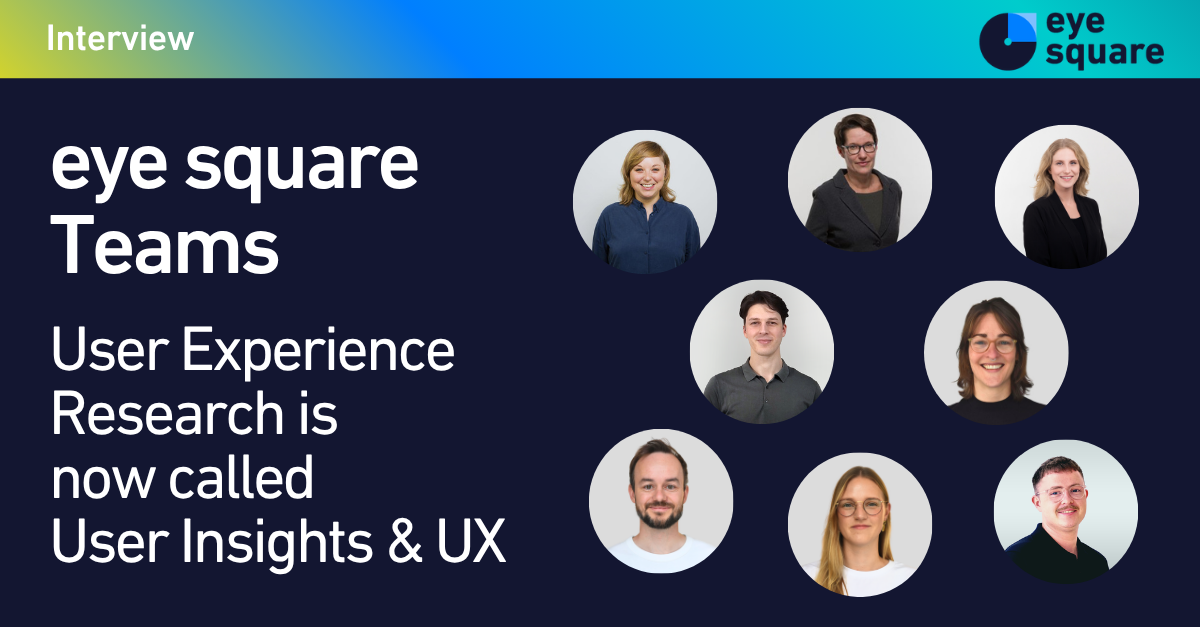
Interview with Dr. Julia Nitschke and Carina Lehne de López Co-Leads Unit User Insights and UX
The first quarter in 2026 kicked off with a big change: our “User Experience Research” team is now called “User Insights & UX.” The reason for this evolution is simple: for many years now, our research has gone beyond product-related topics and we’ve adopted a more holistic perspective. With User Insights, we help you better understand your target audience and their needs, enabling you to make the right strategic decisions! Jan Philipp Goertz interviewed the two co-leaders of our unit.
Q: Julia and Carina, thank you for joining us today. To start, could you tell us about your roles at eye square and your expertise in user insights and strategy?
CL: Thank you for having us! I’m Carina Lehne de López, Chief Experience Officer and Partner at eye square. My role focuses on helping businesses understand human experience on a deeper level — beyond usability or interface design.
JN: And I am Julia Nitschke, VP Insights and Strategy. Together, we are heading our User Insights & UX team and help clients not only optimize their products but also align their strategy and product development with user needs and market trends. We have both consulted our clients from many different industries on all kinds of research matters over many years now.

I saw that you changed your unit’s name and added the term “User Insights”. Why have you done so, and how does this expand the scope of traditional UX research?
JN: The adding of User Insights reflects our broader focus beyond optimizing specific touchpoints, like improving the UX of an app. In addition to product-focused UX tests, we also explore the bigger picture — understanding user needs, motivations, and habits before they even engage with a product or service.
User Insights allow businesses to make strategic decisions about product development and roadmap, communication or market positioning based on what really matters to their (potential) users. It usually comes before developing concrete new features or services.
We have addressed these kinds of research questions for years, but we thought we should finally also show this in our unit name and portfolio, that was focused on UX research only before.
CL: But this is not a shift away from UX research: We still also help our clients with a lot of passion to optimize their products with our UX research!
Could you explain a bit more in detail what User Insights are?
CL: As Julia already mentioned, User Insights go beyond UX research to examine user behavior and preferences on a deeper, strategic level. It’s not just about the “how” of user behavior (e.g., how they use an app) but the “why” behind their actions (e.g., what motivates or prevents them from engaging). Anticipating user needs is crucial in fast-changing markets.
Typically, companies approach us with research questions or situations like these: Are the personas we currently use internally still valid? We need to know our customers better, so our marketing and communication can become more impactful.
We then use segmentation studies to identify distinct user groups and their needs, and we map customer journeys to understand interactions across various brand touchpoints.
A great example is our work for a premium pet food producer, where we helped them tailor their offerings and communication strategies based on distinct user segments, driving better engagement and satisfaction.
What methods do you use in User Insights research, and how do they drive value for clients?
CL: We usually recommend a combination of qualitative and quantitative methods, e.g. in-depth interviews, online surveys, segmentation studies, and customer journeys.
For example, we explored the needs of users in the premium kitchen market in North America for a well-known manufacturer of high-end appliances, combining qualitative and quantitative insights to guide their product development and marketing strategies.
JN: Especially for strategic questions like these, a mixed-methods approach is ideal: qualitative insights to get a real understanding of underlying needs and habits and quantifying to validate the findings and to get an idea about e.g. the potential of an idea.
AI is changing the way users interact with brands and products. Did this play a role in your thinking?
JN: AI was not a reason to give User Insights more of a stage, but of course AI plays a big role – for companies, their consumers and how they will interact.
Carina just mentioned customer journeys, let’s take them as an example: AI shopping agents are going to change user behavior in eCommerce fundamentally. Shopping agents are intelligent systems that assist users in making purchase decisions by searching for products, comparing options, and maybe even completing transactions on their behalf.
Traditional touchpoints like browsing and searching might be more or less replaced by AI-mediated decision-making. This transformation reduces direct interactions between users and brands. Platforms like Amazon and Walmart are already leveraging AI shopping assistants, showcasing the growing importance of this technology. So, if we explore customer journeys in our research, they are going to change fundamentally in the next years – and we will also have to adapt our research approaches accordingly.
And what other impact does AI have on your research?
JN: It also has an impact on the way research works. AI gives us new tools – such as AI-moderated interviews, evaluation with the help of AI or even predictions instead of ‘real’ data.
By the way, we recently had webinars on these aspects: How AI can assist in research and the impact of shopping agents on the customer journey. You can still find the recordings in our Insights section on the website.
What do you think is coming up next for the User Insights & UX Unit? Could you give me a brief outlook on what lies ahead?
CL: Our goal has always been to help businesses make informed, user-centered decisions that drive innovation and create value for their customers. This won’t change in the future. By staying ahead of trends and leveraging cutting-edge research methods, we’re confident we can achieve this. Furthermore, we will see how the market develops and we will embrace that change.
Ultimately, we will stay curious and be passionate about bringing our clients closer to their users.
Thank you both for sharing your insights today. It’s been… a fascinating insight!
Julia and Carina: Thank you! It was a pleasure.
About

Dr. Julia Nitschke
VP Insights & Strategy
Julia Nitschke holds a Ph.D. in psychology and heads the Digitalization and Consulting division at eye square.
She has many years of experience in market research and, on the client side, in product management and business development. Dr. Nitschke provides consulting services in the areas of digitalization, business development, user experience, and agile processes.
Carina Lehne de López
Chief Experience Officer & Partner
Carina Lehne de López has been with the User Experience unit at eye square since 2007 and has served as Unit Lead since 2010.
She holds a Diploma in Sociology, specializing in methods and media sociology.
Carina manages key accounts, sales, the development of user experience research methodologies, consulting, and study control in UX.
Her expertise includes qualitative methods, emotion tracking, personas, and iterative User Experience consulting during product development.
Carina enhances the team’s interdisciplinary knowledge with her intercultural methodological expertise and extensive experience in UX consulting.